Fragments of the quantum circuit model
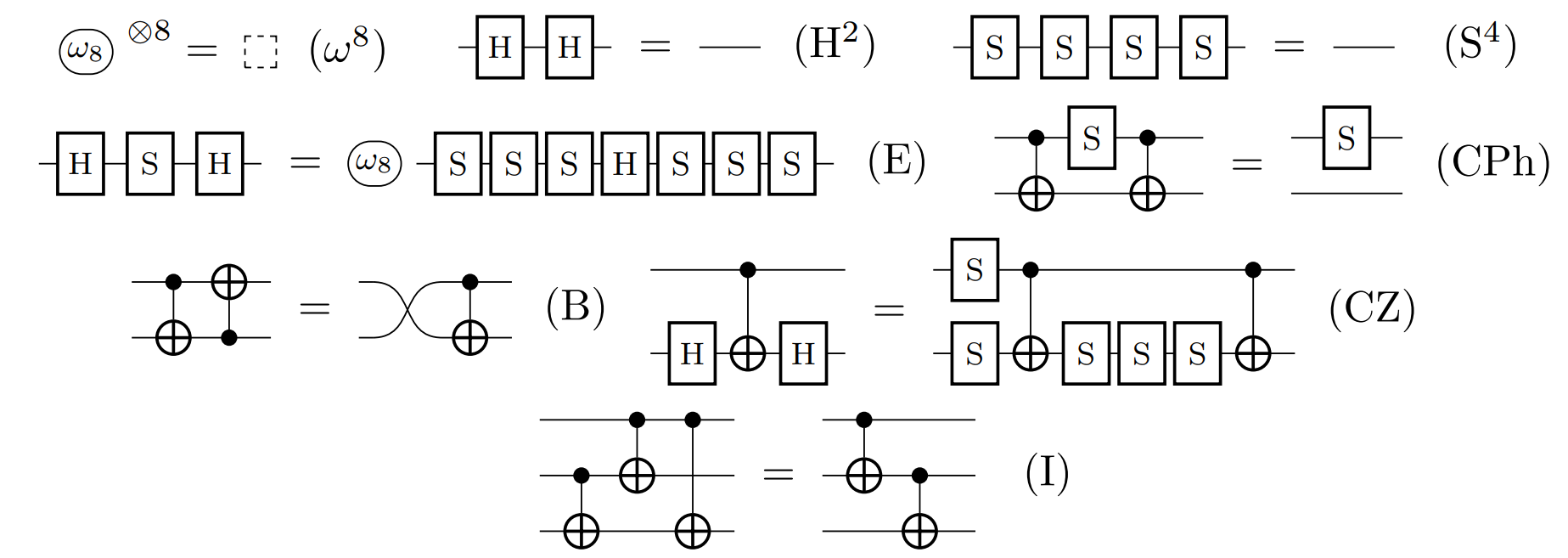
This page is a compact atlas of quantum “circuit fragments.” Fix a set of allowed gates , and consider everything you can build by composing those gates into unitary circuits (on any number of qubits). That “everything you can build” is the fragment generated by .
If you like a concrete metaphor: a gate set is your bag of LEGO bricks; a fragment is the class of circuits you can assemble from them.
The atlas table near the end is meant to answer three practical questions for many common gate sets:
- Expressivity: what family of unitaries do you get (exactly)?
- Reasoning: do we have a usable “law book” of rewrite rules to prove two circuits equivalent?
- Canonical shape: do we have a normal form (a deterministic standard form) to compare circuits by rewriting?
Background you need to read the atlas
A quantum circuit is a sequence (and parallel combination) of small reversible operations called gates, acting on wires called qubits. The “math model” underneath is linear algebra, but you only need a few translation rules.
States
A (pure) 1‑qubit state is written
The numbers are complex amplitudes. Their squared magnitudes give measurement probabilities: , . Phases in those amplitudes are what make interference possible.
With qubits, you have one amplitude per classical bitstring:
Combining subsystems is expressed with the tensor product . For two qubits this is the usual basis , and in general .
Gates and composition
In this article, a “gate” means a unitary transformation : it preserves norms (hence probabilities), and satisfies
Once you choose a basis, applying a gate is .
Two compositions show up constantly:
- Sequential composition: if implements and implements , then “do then ” implements .
- Parallel composition: if acts on qubits and on qubits, then side‑by‑side acts as on qubits.
A compact notation you’ll see below is : the set of all unitary matrices (so qubits live in dimensions).
Gate sets and fragments
A gate set is just the list of primitives you allow, for example
The fragment generated by is the class of circuits you can build from those gates (reusing them arbitrarily), together with identity wires and wire‑rearrangements, and closed under sequential and parallel composition.
I will write H+S+CNOT to mean “the fragment generated by these gates.” The + is not addition; read it as “together with.”
Why fragments matter in practice
Fragments aren’t just a theoretical game. Real devices expose a finite menu of calibrated operations, fault-tolerant architectures make some gates dramatically cheaper than others (the familiar “Clifford cheap, non‑Clifford expensive” pattern), and some fragments admit efficient classical simulation. Perhaps most importantly for this page: many fragments come with clean algebraic structure, which is exactly what you want if you’re trying to optimize or verify circuits.
A few quick examples you’ll see echoed in the table:
CNOTalone behaves like invertible XOR‑linear maps on bitstrings.CNOT+Xadds translations, giving affine reversible maps.CNOTplus diagonal phases leads to “parity‑phase” / phase‑polynomial structure.- Adding a small non‑Clifford ingredient (often ) to Clifford frequently jumps you to universal-by-approximation power.
The gates we will use
This is a small dictionary of the generators that appear in the table.
Global phase
A global phase multiplies the whole state vector by a unit‑magnitude complex number. It is invisible to standard measurement statistics, but it matters if you track exact unitary equality rather than “equal up to global phase.”
Two convenient notations are:
Single-qubit gates
Hadamard . Turns computational basis information into phase information (and vice versa), creating equal superpositions from and :
Pauli and . flips ; flips the sign of :
Phase gate family . Applies a phase to and does nothing to :
Special cases:
Useful identities you’ll often use implicitly include , , and (mod ).
Some libraries use instead of ; this differs only by a global phase convention.
Two-qubit controlled gates
CNOT. A coherent XOR on the target, controlled by the control:
with matrix
Controlled phase . Adds a phase only on :
Special cases:
A quick map of the fragment landscape
Some fragments are purely local (only 1‑qubit gates) and can never create entanglement; others include an entangling 2‑qubit gate (like CNOT or CZ) and can generate correlations across wires.
Inside the “classical reversible” corner sit fragments that only permute computational basis states (no superpositions). CNOT gives linear reversible maps over , while CNOT+X gives affine maps . In group language these are and .
The stabilizer / Clifford region is generated by CNOT+H+S. This is the classic boundary for efficient stabilizer simulation (Gottesman–Knill) and a workhorse of fault-tolerant design.
Just beyond Clifford, fragments such as CNOT+T and more generally CNOT+P(\theta) retain strong structure: CNOT networks compute XOR‑parities, and phase gates attach phases conditioned on those parities. This “parity‑phase” viewpoint is a big reason these families admit specialized synthesis and optimization.
Finally, if you allow a continuous family of 1‑qubit rotations (like all ) plus an entangling gate such as CNOT (and usually ), you reach full universality: you can generate all of . With a discrete non‑Clifford gate like , you get the standard universal‑by‑approximation library (Clifford+T).
Reasoning inside a fragment: equations and normal forms
The table below tracks not only expressivity, but also what is known about reasoning inside each fragment.
An equational theory is a collection of sound rewrite rules: small circuit identities you can apply locally to transform circuits without changing the implemented unitary. A theory is complete if every true equality in the fragment is derivable, and minimal if none of its rules is redundant.
A normal form is a deterministic standard shape for circuits in the fragment. If every circuit rewrites to a unique normal form, equivalence checking becomes “normalize both and compare.”
The atlas: how to read the fragment table
The table has six columns: Generators (the gate set), Math. name (the standard algebraic object on qubits, often up to global phase), Alternative name (common circuit/compiler terminology), and then three “reasoning” flags: Complete (known complete equational theory), Minimal (known minimality), and Normal Form (known deterministic normal form).
Notation in the cells is intentionally compact: ☑️ [k] means established in reference (or a standard finite‑group presentation), ~ [k] means only for bounded qubit counts or special cases, and ? means the best reference isn’t pinned down here.
The atlas table (qubits)
| Generators | Math. name | Alternative name | Complete | Minimal | Normal Form |
|---|---|---|---|---|---|
| Discrete global phases | ☑️ [1] | ☑️ [1] | ☑️ [1] | ||
| All global phases | ☑️ [2] | ☑️ [2] | ☑️ [2] | ||
| Local Pauli‑ (bit flips) | ☑️ [1] | ☑️ [1] | ☑️ [1] | ||
| Local Pauli‑ | ☑️ [1] | ☑️ [1] | ☑️ [1] | ||
| Local phase () gates | ☑️ [1] | ☑️ [1] | ☑️ [1] | ||
| T | Local T / gates | ☑️ [1] | ☑️ [1] | ☑️ [1] | |
| Local ‑rotations | ☑️ [2] | ☑️ [2] | ☑️ [2] | ||
| Local real Clifford (no entangling) | ☑️ [5] | ☑️ [16] | ☑️ [5] | ||
| Local Clifford (no entangling) | ☑️ [4] | ☑️ [16] | ☑️ [4] | ||
| Local Clifford+T (no entangling) | ☑️ [6] | ☑️ [16] | ☑️ [11] | ||
| Local unitaries () | ☑️ [9] | ☑️ [9] | ☑️ [9] | ||
| Projective Pauli (Paulis mod global phase) | ☑️ [20] | ☑️ [20] | ☑️ [20] | ||
| Pauli group ( qubits) | ☑️ [15] | ☑️ [15] | ☑️ [21] | ||
| Local dihedral (order 8) | ☑️ [3] | ☑️ [3] | ☑️ [3] | ||
| Local dihedral (order 16) | ☑️ [3] | ☑️ [3] | ☑️ [3] | ||
| Local dihedral (2‑power) | ☑️ [3] | ☑️ [3] | ☑️ [3] | ||
| Local monomial unitaries | ? | ? | ? | ||
| Graphs | ? | ? | ? | ||
| Linear reversible | ☑️ [12] | ? | ☑️ [12] | ||
| ? | CNOT+H circuits | ? | ? | ? | |
| Affine reversible | ☑️ [14] | ? | ☑️ [14] | ||
| CNOT+Z circuits | ? | ? | ? | ||
| ? | CNOT+S circuits | ? | ? | ? | |
| ? | CNOT+T circuits | ? | ? | ? | |
| Phase-polynomial circuits | ? | ? | ? | ||
| Real stabilizer circuits | ☑️ [5] | ☑️ [16] | ☑️ [5] | ||
| ? | Real stabilizer+CH circuits | ☑️ [22] | ? | ? | |
| Stabilizer / Clifford circuits | ☑️ [4] | ☑️ [16] | ☑️ [4] | ||
| Clifford+T | ~ [6] | ~ [16] | ~ [6] | ||
| Universal | ☑️ [9] | ☑️ [9] | ? | ||
| Universal with native control | ☑️ [22] | ? | ? | ||
| CNOT+Pauli (mod phase) | ~ [8] | ~ [16] | ~ [8] | ||
| CNOT+Pauli | ? | ? | ? | ||
| ? | CNOT-dihedral circuits | ~ [8] | ~ [16] | ~ [8] | |
| ? | CNOT-dihedral circuits | ☑️ [8] | ☑️ [16] | ☑️ [8] | |
| ? | Generalised CNOT-dihedral | ~ [8] | ~ [16] | ~ [8] | |
| Affine phase-polynomial | ? | ? | ? | ||
| ? | Clifford+Toffoli | ? | ? | ? | |
| Clifford+CS | ~ [7] | ~ [16] | ~ [7] | ||
| Diagonal Clifford | ? | ? | ☑️ [12] | ||
| Borel subgroup | ? | ? | ? | ||
| ? | Diagonal commuting phase gates | ? | ? | ? | |
| Reversible Boolean functions | ? | ? | ? | ||
| Symmetric group | ☑️ [13] | ? | ? | ||
| Weyl group | ? | ? | ? | ||
| ? | SWAP+CZ circuits | ? | ? | ☑️ [12] |
Qudits (non-qubit rows)
| Dim. | Generators | Math. name | Alternative name | Complete | Minimal | Normal Form |
|---|---|---|---|---|---|---|
| 3 | ? | Qutrit stabilizer | ☑️ [10] | ~ [16] | ☑️ [10] | |
| d | ? | Qudit stabilizer | ? | ? | ? | |
| 3 | ? | Qutrit Clifford+T | ? | ? | ☑️ [17] | |
| d | ? | Qudit Clifford+T | ? | ? | ☑️ [18] | |
| 3 | ? | Qutrit Clifford+R / Metaplectic | ? | ? | ? | |
| 3 | Clifford-cyclotomic (degree ) | Qutrit Toffoli+Hadamard , Clifford+ | ? | ? | ~ [19] | |
| d | ? | Qudit universal with native control | ☑️ [23] | ? | ? |
Fragment inclusions and quick derivations (qubits, )
These are small “if you have X, you automatically have Y” facts. They matter because they prevent you from listing redundant generators.
From powers and conjugation
If you repeat a gate, or conjugate one gate by another, you often get new generators “for free.” For instance gives because , gives because , and together with gives via .
graph TD
  subgraph G["Gate-level derivations (inside a fragment)"]
    T["T"] -->|"T^2 = S"| S["S"]
    S -->|"S^2 = Z"| Z["Z"]
    HZ["H + Z"] -->|"HZH = X"| X["X"]
  end
Discrete global phase from non-commuting 1q gates
When you track exact unitaries (not just “up to global phase”), non‑commutation can generate scalar phases via a commutator-like loop.
- implies , since
- In particular, implies , because .
Controlled-phase from CNOT + phases
A very common identity is that controlled phases can be built from CNOTs plus single-qubit -rotations:
So CNOT+S gives (take ), CNOT+T gives (take ), and more generally CNOT + P(θ/2) gives CP(θ).
graph TD
  subgraph C["Controlled-phase from CNOT + phases"]
    CN_S["CNOT + S"] -->|"gives CZ"| CZ["CZ"]
    CN_T["CNOT + T"] -->|"gives CS"| CS["CS"]
    CN_P["CNOT + P(θ/2)"] -->|"gives CP(θ)"| CP["CP(θ)"]
  end
CNOT vs CZ (with Hadamard)
CNOT and CZ are equivalent up to Hadamards on the target:
So CNOT+H gives CZ, and CZ+H gives CNOT.
graph TD
  subgraph D["Some inclusions"]
    H["⟨H⟩"]
    S["⟨S⟩"]
    X["⟨X⟩"]
    Z["⟨Z⟩"]
    T["⟨T⟩"]

    HStmp((  ))
    HStmp --> HS["⟨H+S⟩"]
    H --> HStmp
    S --> HStmp

    S --> T
    Z --> S

    HTtmp((  ))
    HTtmp --> HT["⟨H+T⟩"]
    H --> HTtmp
    T --> HTtmp

    HXtmp((  ))
    HXtmp --> HX["⟨H+X⟩"]
    H --> HXtmp
    X --> HXtmp

    HZtmp((  ))
    HZtmp --> HZ["⟨H+Z⟩"]
    H --> HZtmp
    Z --> HZtmp

    HS --> HT
    HZ --> HS

    HX <-.-> HZ

    XTtmp((  ))
    XTtmp --> XT["⟨X+T⟩"]
    X --> XTtmp
    T --> XTtmp

    XStmp((  ))
    XStmp --> XS["⟨X+S⟩"]
    X --> XStmp
    S --> XStmp

    XZtmp((  ))
    XZtmp --> XZ["⟨X+Z⟩"]
    X --> XZtmp
    Z --> XZtmp

    XS --> XT
    XZ --> XS

    XT --> HT
    XS --> HS
    XZ --> HZ

    HT <-.-> HTX["⟨H+X+T⟩"]
    HS <-.-> HSX["⟨H+X+S⟩"]
    HZ <-.-> HZX["⟨H+X+Z⟩"]
  end
References
[1] https://proofwiki.org/wiki/Cyclic_Group/Group_Presentation
[3] https://proofwiki.org/wiki/Dihedral_Group/Group_Presentation
[4] https://arxiv.org/abs/1310.6813
[5] https://arxiv.org/abs/2109.05655
[6] https://arxiv.org/abs/2204.02217
[7] https://arxiv.org/abs/2306.08530
[8] https://arxiv.org/abs/1701.00140
[9] https://arxiv.org/abs/2311.07476
[10] https://arxiv.org/abs/2508.14670
[11] https://arxiv.org/abs/1312.6584
[12] https://arxiv.org/abs/2012.09224
[13] https://www.math.auckland.ac.nz/~conder/preprints/SymGpPresentations.pdf
[14] https://www.sciencedirect.com/science/article/pii/S0022404903000690
[15] https://groupprops.subwiki.org/wiki/Central_product_of_D8_and_Z4
[16] https://hal.science/hal-05502157v1/file/main.pdf
[17] https://arxiv.org/abs/1803.03228
[18] https://arxiv.org/abs/2011.07970
[19] https://arxiv.org/abs/2405.08136
[20] https://en.wikipedia.org/wiki/Klein_four-group
[21] https://en.wikipedia.org/wiki/Pauli_group
[22] https://hal.science/hal-05487235
Comments