Categories, PROPs, and control: a compositional language for circuit reasoning
When people first meet category theory, they often meet it as a strange zoo of abstract definitions.
This post takes a different route:
- start from circuits (things you can plug together),
- notice the two ways you compose them (serial + parallel),
- and then explain why categories, PROs, PROPs, and finally controlled PROPs are a very natural ”language layer” for reasoning about circuits by rewriting.
1. What is a category?
A category is the smallest piece of mathematics that can talk about composition in a principled way.
1.1 The definition
A category consists of:
- objects
- morphisms (arrows)
- a composition operation: if and , then
- an identity arrow for every object
subject to two axioms:
- Associativity: whenever both sides make sense.
- Unit laws: and for every .
That’s it.
A useful mental model is:
Objects are ”types of things”, morphisms are ”processes”, and composition is ”do one after the other”.
If you want a friendly motivational video, these ones have the right vibe:
1.2 A picture you can keep in your head
A category is like a directed graph where some paths are declared equal because they represent the same composite process.
flowchart LR
  A((A)) -->|f| B((B))
  B -->|g| C((C))
  A -->|g∘f| C
The whole point is: if you can compose, you can reason modularly.
1.3 Examples (this is where the definition stops being abstract)
Here are some categories you already know:
-
Set objects = sets, morphisms = functions.
-
Vect_k objects = vector spaces over , morphisms = linear maps.
-
Posets as categories Any partially ordered set is a category where:
- objects = elements of
- there is a morphism iff
- composition is forced (and unique when it exists).
These are called thin categories: between any two objects there is at most one arrow.
-
Monoids as categories (the ”one-object trick”) A monoid is exactly the same as a category with:
- one object
- morphisms are elements of
- composition is multiplication, identity is .
This last example is more important than it looks: it’s the first hint that algebraic structure can be encoded as categorical structure.
2. A little history and why anyone invented this
Category theory was introduced by Eilenberg and Mac Lane (1940s) as a way to formalize patterns of construction that kept recurring in topology and algebra.
But its modern ”engineering” motivation is almost embarrassingly simple:
If your subject has composable things, you want a calculus where ”plugging things together” is the primitive operation.
This is why categories show up in:
- programming language semantics (”programs are arrows”),
- logic (”proofs are arrows”),
- circuit theory (”circuits are arrows”),
- and of course quantum information (”processes are arrows”).
3. Categories are not enough for circuits
A plain category only knows how to do sequential composition.
But circuits have two compositions:
- Sequential: plug outputs into inputs (”do this then that”).
- Parallel: place side-by-side on separate wires (”do both independently”).
To model that second one, we need one extra layer of structure.
4. Monoidal categories: ”and also in parallel”
A monoidal category is a category equipped with a tensor product that behaves like ”parallel composition”.
Concretely, it gives you:
- for objects: (”system A together with system B”)
- for morphisms:
and a distinguished unit object (”no system”), plus coherence laws ensuring everything associates nicely.
4.1 Why monoidal categories match circuit diagrams
String diagrams are the reason this is such a good fit:
- wires represent objects,
- boxes represent morphisms,
- vertical stacking is composition,
- horizontal juxtaposition is tensor.
In that world, many ”proofs” are just topological deformations of pictures.
5. PROs: a monoidal category of arities
Now we specialize monoidal categories to something very circuit-like.
A PRO (short for ”PROduct category”, historically) is:
a strict monoidal category whose objects are the natural numbers , with tensor on objects given by addition:
Interpretation: object is ” wires”.
A morphism is ”a box with input wires and output wires”.
5.1 What PROs give you (and what they don’t)
PROs capture planar wiring: you can compose and put side-by-side, but you do not automatically get wire swaps.
This is already enough to encode a lot of algebra.
5.2 Example: the PRO for monoids
A (not-necessarily-commutative) monoid has two operations:
- multiplication
- unit
with equations:
- associativity:
- unitality:
In a PRO, these equations are literally equations between diagrams.
This is one of the deep ideas behind PROs/PROPs:
They let you treat an algebraic theory as a diagrammatic rewriting system.
6. PROPs: PROs + permutations = real circuit wiring
Most circuit languages allow you to swap wires.
Categorically, this is symmetry.
A PROP (”PROduct and Permutation category”) is a PRO equipped with:
- for every , a symmetry isomorphism
- satisfying the usual coherence laws (so permutations behave like permutations)
Equivalently:
A PROP is a strict symmetric monoidal category whose objects are natural numbers.
6.1 Why quantum circuits fit in PROPs so naturally
In a circuit model:
- object means ” qubits” (or qudits, or wires in general)
- morphisms are unitary circuits on wires
- tensor is ”put circuits side-by-side”
- symmetry is SWAP / wire permutation
So, at the level of pure syntax + wiring, a quantum circuit language is basically a presented PROP.
This is exactly what you want when building rewrite engines: you don’t want every rule to keep re-proving ”SWAP behaves like a swap”.
7. Presentations: ”a circuit language = generators + relations”
If you’ve seen group presentations (”generators and relations”), this is the same idea, one categorical level up.
A presented PROP consists of:
- a set of generating gates (morphisms of various arities)
- a set of equations (relations) between diagrams
- and then you take the free PROP generated by those gates modulo those equations
This is not just philosophy. It is literally how many ”complete rulebooks” are stated:
- choose generators,
- list rewrite rules,
- prove they are sound and (ideally) complete.
8. The idea of ”control” as structure
Now we come to the central theme that motivates controlled PROPs.
In circuits, control is not a single gate: it’s a pattern.
For qubits, controlling gives CNOT. Controlling a whole subcircuit gives a controlled subcircuit.
So control is naturally an operation on circuits, not just another circuit.
8.1 The pain point (why this matters for rewriting)
If control is treated only as a derived gadget, then a complete theory often needs rules that mention arbitrarily many control wires, because ”multi-control” is unbounded.
A different design choice is:
Treat control as a primitive constructor with its own coherence laws.
Then you get a powerful meta-rule:
If , then their controlled versions are equal automatically.
That single principle is a massive compression of a rewrite theory.
9. Controlled PROPs (Delorme–Perdrix): control as a functor
One clean formalization is due to Delorme and Perdrix.
9.1 The core definition
Let be a PROP, and let denote the subcategory of endomorphisms (i.e. morphisms ).
A control functor is a functor
that:
- sends each object to (adds one control wire),
- sends each endomorphism to a controlled version ,
- and satisfies a small set of coherence laws saying that nested controls commute appropriately and that control interacts well with the PROP’s symmetries.
In other words:
A controlled PROP is a PROP equipped with such a control functor.
9.2 What this buys you immediately
The defining property of a functor is that it preserves:
- composition:
- identities:
So ”control distributes over doing things in sequence” is built in for free.
And because this is a functor on the equational theory:
if your rewrite rules prove , you automatically get .
That is exactly the kind of ”lifting” you want in a rewrite engine.
9.3 What does control mean semantically?
In finite-dimensional Hilbert spaces (the usual quantum model), the standard qubit control-on- operation is:
For qudits of dimension , you can control on any basis value :
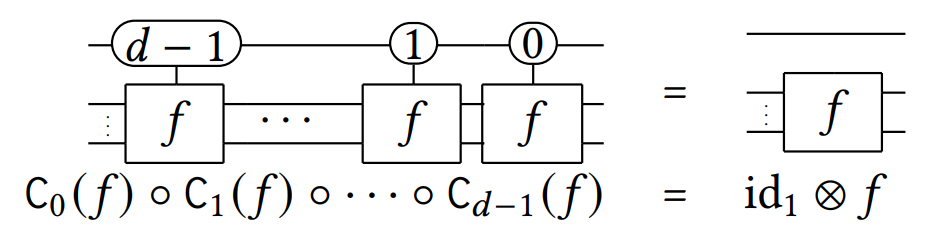
This is the clean ”block-diagonal” picture: apply on the target only in the control subspace you selected.
9.4 Points: ”true” and ”false” for control
A pleasant extra feature is the notion of points for a control functor: two special states (diagrammatically: morphisms) that:
- annihilate the controlled operation (”false”)
- fire the controlled operation (”true”)
This captures, abstractly, the idea that plugging into the control wire makes the controlled circuit behave like identity, while plugging makes it behave like .
10. Polycontrolled PROPs: control comes in families
For qubits there are already multiple reasonable ”control choices” (control on , on , on , etc.), related by conjugating the control wire.
For qudits, something even more canonical happens:
There are natural basis controls: control-on-, …, control-on-.
So one is led to a PROP equipped with a family of control functors:
Once you have multiple control functors, you can ask structural questions:
- do they commute (in some sense)?
- are they exhaustive (do they ”cover” all basis cases)?
- how do they relate by conjugation?
These are not ”quantum-specific” questions; they’re about the wiring logic of control.
11. Controlled PROPs (Heunen–Kaarsgaard–Lemonnier): eight equations for computational control
A complementary approach comes from Heunen, Kaarsgaard, and Lemonnier, who isolate control as a tiny equational theory.
11.1 Start from a ”crop” (a prop of endomorphisms + a NOT)
They introduce a controllable prop (they abbreviate ”crop”):
- a prop whose morphisms are endomorphisms ,
- equipped with a distinguished involution (think NOT), with .
From this base, they freely adjoin controlled versions of morphisms.
11.2 Two controls (positive and negative)
They use two endofunctors:
- : ”control on 1” (positive control)
- : ”control on 0” (negative control)
and show you only need a small, interpretable list of equations—eight of them—to govern how control behaves.
11.3 What the equations mean (informal reading)
The eight equations include:
- functoriality: controlled composition and controlled identity behave as expected
- strength: control ignores extra unused wires (it behaves well under adding identities)
- colour change: positive and negative control relate by conjugating with NOT
- complementarity: doing both controls amounts to ”always do ”
- commutativity: controls of opposite polarity commute appropriately
- swap / swap coherence: nested controls interact properly with wire swapping
One way to read their result is:
Control is not ”a million different controlled gates”. It’s a small structural theory you can add on top of any base circuit theory.
They also connect this syntactic construction to a semantic universal property: the controlled theory corresponds to a free kind of ”rig-like” categorical structure.
12. Why this matters for rewriting and completeness
At this point you can see the strategic advantage:
-
A PROP presentation of a circuit language separates:
- wiring bureaucracy (structural laws)
- fragment-specific gate identities
-
A controlled PROP adds one more structural layer:
- ”control is a constructor” with coherence laws
And this changes the shape of rewrite systems you can hope for.
The slogan becomes:
Make control structural, and local rewrite systems become possible.
References and further reading
-
Delorme & Perdrix, Diagrammatic Reasoning with Control as a Constructor, Applications to Quantum Circuits: https://arxiv.org/abs/2508.21756
-
Heunen, Kaarsgaard & Lemonnier, One rig to control them all: https://arxiv.org/abs/2510.05032
-
My paper (the qudit completeness result framed via polycontrolled PROPs): https://arxiv.org/abs/2602.09873
-
For a classic textbook introduction:
- S. Mac Lane, Categories for the Working Mathematician.
-
For string diagrams and monoidal categories (highly recommended once you’re comfortable):
- A. Joyal & R. Street, work on string diagrams (many expositions exist).
- P. Selinger, survey material on dagger compact categories and quantum processes.
Comments